Effective Product Ownership is about more than managing a backlog — it is about creating clarity, establishing direction, and making tradeoffs that maximize value.
By Project Brilliant Team
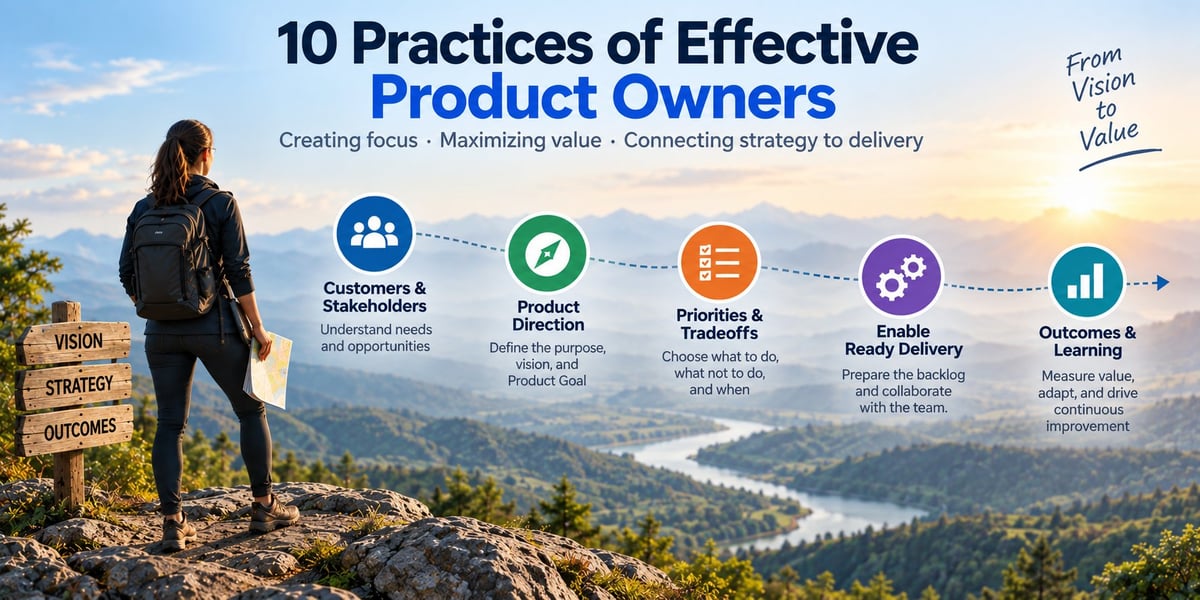
Scrum defines the Product Owner as accountable for maximizing the value of the product resulting from the work of the Scrum Team. But knowing the accountability and knowing how to perform the role effectively are two different things.
At Project Brilliant, we believe effective Product Ownership requires more than managing a backlog. Product Owners create clarity, establish direction, make tradeoffs, connect teams to customer and business outcomes, and adapt as they learn.
The specific practices will vary by product and organization, but the following ten practices provide a strong foundation.
One foundational recommendation: treat Product Ownership as a dedicated role. When it becomes a small part of someone's already-full job, strategic product work often gives way to urgent delivery needs.
The Product Owner's job is not to keep a team busy or make sure every stakeholder request gets delivered. It is to continually decide where the team can create the greatest value while protecting the team from too many competing priorities.
The Scrum Guide is explicit about focus: the Product Goal is the long-term objective for the Scrum Team, and the team fulfills or abandons one Product Goal before taking on the next. The Product Owner reinforces that focus by ordering the Product Backlog around the current Product Goal.
Within that Product Goal, the Product Owner should work with the team to determine a healthy level of Feature work in progress. We use "Feature" here to mean a meaningful grouping of smaller Product Backlog Items, such as user stories, enablers, or similar delivery items.
The goal is not to impose an arbitrary WIP limit. It is to avoid the delays, context switching, coordination overhead, and unfinished work that come from starting too much at once.
A few practical behaviors help:
Favor finishing valuable Features before starting more.
Adjust Feature WIP based on what the team learns about flow, dependencies, and throughput.
Make exceptions intentional rather than allowing competing priorities to accumulate.
Remove stale or low-value backlog items.
Clearly communicate what the team is not working on and why.
Focus is not just a team discipline. It is something the Product Owner actively creates and protects.
Product Ownership is difficult to perform well as a side responsibility. Teams need a Product Owner who can clarify intent, make decisions, engage stakeholders, learn from customers, refine future opportunities, and maintain product direction.
A useful starting point is to balance Product Owner time across three areas:
Approximately 1/3 with the Scrum Team to collaborate, clarify intent, refine work, and support timely decisions.
Approximately 1/3 with customers and stakeholders to understand needs, gather feedback, communicate direction, and make tradeoffs visible.
Approximately 1/3 on product thinking and backlog management to analyze evidence, evolve Product Goals, refine future opportunities, and maintain the roadmap and backlog.
This is not a timesheet formula. Some weeks will look very different. The intent is to make sure none of these responsibilities consistently crowds out the others.
Effective Product Owners treat stakeholder alignment as an ongoing conversation, not a periodic presentation.
Products often serve stakeholders with competing needs and perspectives. The Product Owner creates transparency around those demands, gathers input without turning every request directly into backlog work, and communicates what is being pursued, deferred, changed, or declined—and why.
A predictable engagement cadence and clear communication channels help stakeholders know when and how to provide input.
Stakeholder input should inform prioritization. It should not replace Product Owner accountability for prioritization.
Alignment does not mean everyone gets what they asked for. It means people understand the direction, decisions, and tradeoffs.
Teams struggle to refine work when they do not understand who they are helping, what problem they are solving, or why it matters.
Before detailed refinement begins, the Product Owner should create enough context for meaningful collaboration:
Who are we solving this for?
What problem or opportunity are we addressing?
Why does it matter?
What outcome are we trying to create?
How will we know whether it worked?
What assumptions or unknowns could significantly change our approach?
It is also important to maintain enough refined work ahead of active delivery to support healthy flow. As a practical starting point, having roughly three meaningful Ready Features often provides enough runway while preserving flexibility.
A Ready Feature should have enough clarity for the team to begin decomposition and refinement. That typically includes a clear value-focused title, who/what/why context, high-level acceptance criteria or outcome expectations, major assumptions and dependencies, a rough size, and team agreement that there is enough understanding to proceed.
A Ready Feature does not mean that every underlying Product Backlog Item has already been refined and made Ready. It means the Feature has enough clarity, context, and shared understanding for the team to begin breaking it down and refining the smaller backlog items needed for delivery.
When uncertainty is significant, use research, experiments, prototypes, technical spikes, or other discovery work to reduce it.
The objective is not certainty. It is enough shared understanding to make a good next decision.
Teams make better decisions when they understand where the product is going and why. Effective Product Owners establish clear, outcome-oriented Product Goals and maintain a roadmap that communicates direction, priorities, and intended outcomes.
For many products, a roughly 12-month view of Product Goals or strategic outcomes provides useful context, with more detail near-term and progressively less certainty farther out.
The roadmap may show future Product Goals, but the team should have one current Product Goal providing focus for active delivery.
In our experience, Product Goals that are roughly two to four months in size often strike a useful balance: meaningful enough to represent an important outcome, but small enough to maintain focus, inspect progress, learn, and adapt.
A quarterly roadmap review is a useful baseline for revisiting priorities, sequencing, assumptions, and new evidence with stakeholders—while still adapting sooner when conditions change.
A roadmap should communicate intent, not manufacture certainty. If every item twelve months out has precise scope and dates, it may be functioning more like a fixed delivery plan than a tool for communicating direction, priorities, and evolving product choices.
Most products do not exist in isolation. Teams depend on shared services, platforms, vendors, architecture, operations, compliance functions, and other product teams.
Effective Product Owners make those dependencies visible early, communicate regularly with peer Product Owners and shared teams, and help resolve sequencing or priority conflicts before they become delivery surprises.
A shared visual mechanism—a dependency board, program board, roadmap view, or similar tool—can help.
But the visual is not the coordination mechanism. The conversations are.
Backlog refinement should be continuous.
Teams should not enter Sprint Planning discovering the work for the first time, nor should they spend months detailing work they may never build.
As a practical baseline, maintaining approximately two Sprints of Ready Product Backlog Items gives the team enough runway to support predictable delivery while still allowing priorities to change as new information emerges.
Teams should establish a shared understanding of what "Ready for a Sprint" means. The INVEST criteria, introduced by Bill Wake, provides a useful guideline for evaluating whether a Product Backlog Item is sufficiently refined:
Independent — can be delivered with minimal unnecessary dependency on other items.
Negotiable — leaves room for conversation and collaboration rather than prescribing every detail.
Valuable — delivers or contributes to meaningful customer or business value.
Estimable — is understood well enough for the team to reasonably estimate.
Small — is sized so it can be completed within a Sprint.
Testable — has clear enough expectations to determine whether it works as intended.
In addition, a ready Product Backlog Item—whether a user story, enabler, defect, or another type of backlog item—should connect clearly to the current Product Goal and supporting Feature or outcome, include appropriate acceptance criteria and quality expectations, and have meaningful dependencies or constraints identified.
"Ready" should not become a bureaucratic approval gate. Its purpose is to create enough shared understanding that the team can confidently bring the work into a Sprint.
"Done," "released," and "valuable" are not the same thing.
Effective Product Owners think beyond development completion to the full path from idea to realized value. That means considering customer, business, operational, support, compliance, and technical readiness.
It is useful to define what Release Ready means before the release decision needs to be made. Depending on the product, that may include:
Business and customer readiness.
Support and operational readiness.
Security or compliance requirements.
Data migration or training.
Monitoring.
Rollback or recovery considerations.
Smaller releases are often preferable when they reduce risk or accelerate learning. After release, feedback and outcome data should flow directly back into future product decisions.
A successful release is not just software reaching production. It is the product successfully reaching the people and environment it was intended to serve.
A Sprint Review should not become a ceremonial demonstration of completed tickets.
The Scrum Guide describes the Sprint Review as an opportunity to inspect the outcome of the Sprint and determine future adaptations. Effective Product Owners use it to reconnect the Increment to the Product Goal and Sprint Goal, engage stakeholders, gather feedback, and adapt what comes next.
Instead of simply asking "Any feedback?" try questions such as:
What surprised you?
What concerns you?
What would make this more valuable?
What assumptions should we reconsider?
What did we learn that should change what we do next?
The Product Owner should use what emerges from the Review to adapt the Product Backlog and clarify next steps.
The goal of a Sprint Review is not approval. It is learning.
Effective Product Owners do not stop at delivering outputs. They determine whether those outputs created the intended outcomes.
Every meaningful product investment contains assumptions. We believe customers will behave differently, a process will improve, revenue will increase, risk will decrease, or an experience will become easier.
Every significant Product Goal should be able to answer:
"What change are we trying to create, and how will we know whether it happened?"
Product Owners should review qualitative feedback, usage data, business metrics, operational measures, and other relevant signals—and compare actual outcomes with what was expected.
Customer contact should also be routine rather than exceptional. For many Product Owners, a lightweight monthly customer-learning cadence—interviews, usability checks, observation, feedback sessions, or similar activities—is a useful baseline.
You do not need a massive research program. You do need a reliable way to prevent internal assumptions from becoming substitutes for customer evidence.
When the evidence challenges the plan, the Product Owner should be willing to change the plan.
Product Ownership can easily become synonymous with backlog administration, writing stories, attending ceremonies, or keeping a delivery team supplied with work. Those activities may be part of the job, but they are not the purpose of the job.
Effective Product Owners create value by making good decisions under uncertainty. They establish direction, create and protect focus, make difficult tradeoffs, engage customers and stakeholders, enable teams to move, inspect results, and adapt when the evidence tells them to.
The Product Backlog is an important tool.
The real work of Product Ownership is deciding what matters—and helping the team discover the best way to create value.
Project Brilliant helps Product Owners and product teams create clarity, direction, and measurable value through practical coaching and transformation support.
Let's TalkSchwaber, Ken and Jeff Sutherland. The Scrum Guide: The Definitive Guide to Scrum: The Rules of the Game. November 2020. ScrumGuides.org.
Wake, Bill. INVEST in Good Stories, and SMART Tasks. XP123, August 17, 2003. https://xp123.com/invest-in-good-stories-and-smart-tasks/