By Gervais Johnson, Senior Director of AI Strategy, Project Brilliant

I have experienced five technology paradigm shifts from inside the room: the tail end of the mainframe era, the PC revolution, the internet, mobile and cloud, and now AI. Forty years gives you a strange kind of déjà vu. The slide decks change. The vendor logos change. The panic and the promises do not.
Every one of these shifts arrived wearing the same costume. First, a small group of practitioners sees something real. Then the press discovers it, and the hype runs miles ahead of the product. Then a correction happens — a crash, a winter, a "trough of disillusionment" — and the people who left declare the whole thing a fad.1 Then, quietly, while nobody's writing headlines about it anymore, the technology gets boring, reliable, and everywhere. That's the pattern I have seen play out four times. AI represents the fifth paradigm shift for me, emerging and assimilating faster leveraging prior shifts lessons and scaffoldings.
The specifics rhyme in ways that should be reassuring to anyone feeling whiplash right now.
When PCs showed up on desks in the early 1980s, the pitch was that every worker would instantly become more productive. The reality was a decade of spreadsheets replacing ledger paper while the actual organizational payoff — re-engineered workflows, new job categories, new management structures — took years longer to show up in the numbers. Economists have a name for this lag: the productivity paradox. Robert Solow said it best in 1987 — "you can see the computer age everywhere but in the productivity statistics"2 — and it took most of a decade before that changed.
The internet followed the same arc, just compressed. Dot-com mania in the late '90s, a brutal correction in 2000-2002 that wiped out trillions in paper wealth, and then — after the crash, not during the boom — the internet quietly became the substrate for commerce, media, and work. Mobile and cloud repeated it again on a shorter cycle: skepticism about whether anyone would do real work on a phone or trust their data to somebody else's server, followed by both becoming simply how business is done.
AI is following the identical emotional arc. We are, by any reasonable measure, past the initial hype spike and into the part of the cycle where the gap between adoption and actual value becomes visible. McKinsey's 2025 global survey found 88% of organizations now use AI in at least one business function, and generative AI usage jumped from 33% to 72% of organizations in a single year.3 That's PC-in-1985-level penetration achieved in about two years. But the same survey found that despite near-universal adoption, only about 6% of organizations report significant, measurable enterprise-wide financial impact from it. That gap — massive adoption, minimal transformation — is not a sign AI is failing. It's the same gap Solow saw with computers, now showing up on a faster clock.
There's a more precise economic model for this, and it's worth knowing the name: the "Productivity J-Curve." Research by Erik Brynjolfsson and colleagues shows that general-purpose technologies reliably produce a dip before the payoff — because the real value doesn't come from the technology itself, it comes from the expensive, unglamorous work of redesigning processes, retraining people, and restructuring organizations around it. That complementary investment doesn't show up on a balance sheet as an asset; it shows up as a cost, which is why productivity often looks flat or worse in the early years.4 I have watched this happen with ERP systems, the web, mobile, and cloud. It is, without exception, happening again with AI.
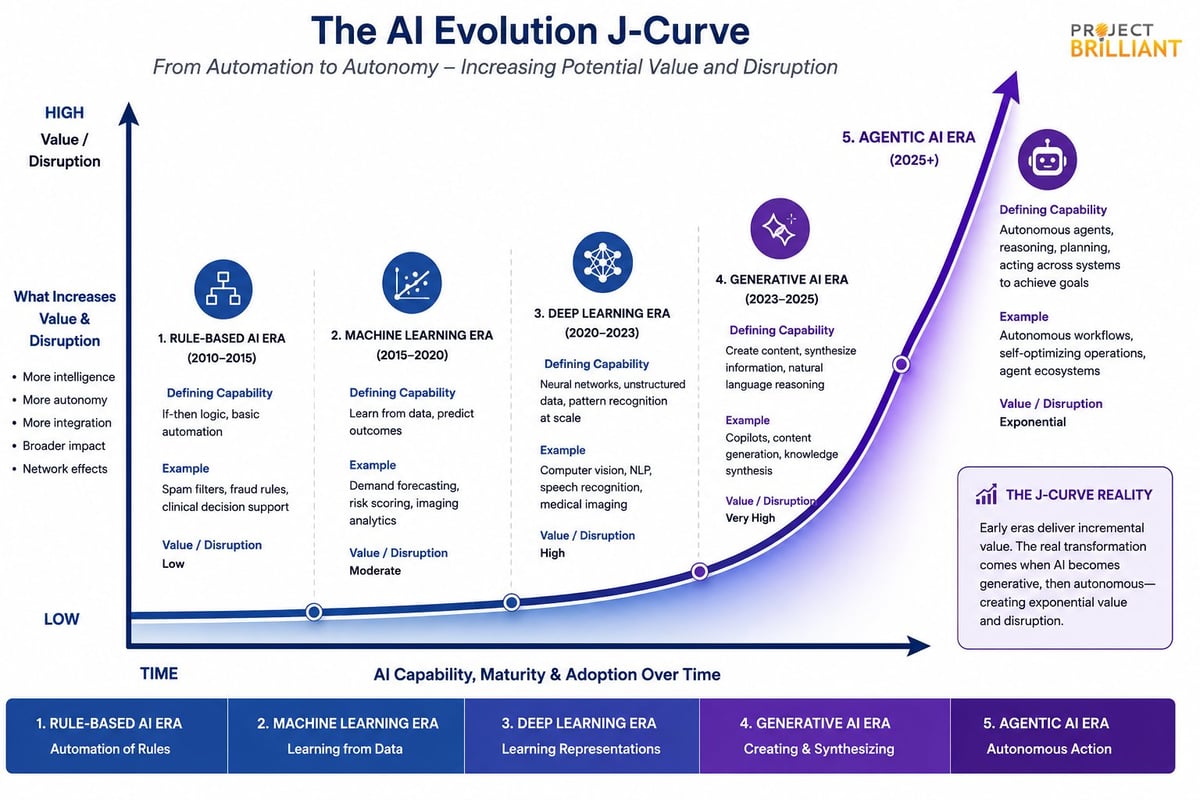
Here is what's different, and why it matters.
Every prior shift I lived through had a physical constraint — wires to run, hardware to ship, networks to build — that put a natural governor on how fast adoption could occur. Electricity took 48 years to reach nearly all U.S. households; landline telephone service took closer to a century to peak.5 The internet compressed that to about a couple of decades. AI has compressed it again, to almost nothing: ChatGPT reached 100 million users in two months. TikTok, itself considered a fast adopter, took nine months to do the same; Instagram took roughly two and a half years.6 There is no factory, no cable, no spectrum auction gating AI adoption. That is genuinely new, and it means the usual "early majority takes years to show up" assumption from classic diffusion-of-innovation models doesn't hold the way it used to.
Every previous paradigm shift I've worked through changed how we did a category of work — how we computed, communicated, or transacted. AI is the first one aimed at cognitive work itself: judgment, synthesis, drafting, coding, analysis — the tasks we used to assume only credentialed humans could do. That changes the workforce conversation from "new tool, new skill" to something closer to "which tasks still need a human, and why." The World Economic Forum's 2025 Future of Jobs survey of over 1,000 global employers estimates 92 million roles will be displaced by 2030 against 170 million created — a net gain, but a much larger churn than prior transitions, with 39% of core workforce skills expected to change and 59% of workers needing retraining in that window.7
The human-machine workforce and business transformations are evolving quickly and the early results are impressive. We are in the early stage of AI adoption and value realization. There are five critical actions business leaders need to execute now:
Develop and maintain a practical cohesive Enterprise AI Transformation Strategy aligned to business goals.
Concentrate investments on a few enterprise high value initiatives that improve productivity, accelerate growth, and create strategic advantage.
Lead the workforce transformation to an AI Native culture within a product-platform organization structure as a business imperative and responsibility.
Implement Enterprise AI Governance Operating System to prioritize AI investments, manage risk, measure outcomes, and redesign end-to-end business processes rather than automating individual tasks.
Establish an AI Transformation and Value Office led by C-Suite executives responsible for driving adoption and value across the organization.
I have been lucky to be part of all the major technology paradigm shifts since 1976, and now with AI. I like working and living on the precipice of something bold and new. Always learning and applying to real-world problems and opportunities. A disruptor at heart.
The lesson I keep relearning is that the winners in every one of these shifts were never the first to hype it or the loudest to dismiss it. They were the ones who used the trough — the boring, unglamorous, post-hype period — to do the organizational work: redesign the process, retrain the team, redefine the roles, before the technology got interesting again. That's not a technology strategy. It's a business and workforce transformation with a serious human-change-management strategy wearing technology's clothes, and it has now worked five times in a row.
The hype cycle is real. The trough is real. And so is what comes after it, for the organizations willing to do the unglamorous work while everyone else is arguing about whether AI is overhyped or underhyped. It's both, at the same time, like every paradigm shift before it — just running faster than any of us have ever seen.
The organizations that will win in the AI Era will redesign work, develop people, and build the human-machine operating system to convert AI adoption into measurable value.
AI Disclosure: I used my writing assistant Claude Sonnet 5 to help me draft, review, and edit this story. In my own words and tone. It is based on a real person, me. I am a paradoxical human running as fast as I can living with my truth, and not ready to slow down or "retire."
Project Brilliant Recognition: I thank Grace Sondermann, Andy Lien, and Aaron Kopel for their ideas, editing, and collaboration.
1 Gartner uses "Peak of Inflated Expectations" and "Trough of Disillusionment" as named phases in its Hype Cycle methodology, applied most recently in the Hype Cycle for Artificial Intelligence, 2025. Gartner, "The Latest Hype Cycle for Artificial Intelligence Goes Beyond GenAI," 2025, https://www.gartner.com/en/articles/hype-cycle-for-artificial-intelligence.
2 Robert Solow, "We'd Better Watch Out," New York Times Book Review, July 12, 1987. Discussed in Erik Brynjolfsson, Daniel Rock, and Chad Syverson, "Artificial Intelligence and the Modern Productivity Paradox: A Clash of Expectations and Statistics," NBER Working Paper No. 24001, National Bureau of Economic Research, 2018, https://www.nber.org/system/files/working_papers/w24001/w24001.pdf.
3 McKinsey & Company, "The State of AI: How Organizations Are Rewiring to Capture Value," Global Survey, March 2025 (fieldwork June 25–July 29, 2025; 1,993 respondents across 105 countries), https://www.mckinsey.com/capabilities/quantumblack/our-insights/the-state-of-ai.
4 Erik Brynjolfsson, Daniel Rock, and Chad Syverson, "The Productivity J-Curve: How Intangibles Complement General Purpose Technologies," NBER Working Paper No. 25148, National Bureau of Economic Research, 2018, https://www.nber.org/system/files/working_papers/w25148/w25148.pdf; MIT Initiative on the Digital Economy, research brief, 2019, https://ide.mit.edu/sites/default/files/publications/2019-04JCurvebrief.final2_.pdf.
5 Comparative technology adoption timelines (electricity, telephone, internet), as compiled in "Technology Adoption Rate Statistics," Digital Adoption, https://www.digital-adoption.com/technology-adoption-rates-statistics/; see also Visual Capitalist, "Charted: The Speed at Which New Technologies Go Mainstream," https://www.visualcapitalist.com/charted-the-speed-at-which-new-technologies-go-mainstream/.
6 UBS analysis and comparative adoption timelines for TikTok and Instagram, as reported in TIME, "Why ChatGPT Is the Fastest Growing Web Platform Ever," https://time.com/6253615/chatgpt-fastest-growing/.
7 World Economic Forum, Future of Jobs Report 2025, January 2025 (survey of 1,000+ employers representing 14 million+ workers across 22 industry clusters and 55 economies), https://www.weforum.org/publications/the-future-of-jobs-report-2025/.
The State of AI: How Organizations Are Rewiring to Capture Value (2025). Key finding: Workflow redesign is the strongest predictor of enterprise value realization from GenAI. https://www.mckinsey.com/capabilities/quantumblack/our-insights/the-state-of-ai
Stanford HAI AI Index Report 2026. Key finding: AI adoption is widespread, but enterprise transformation and value realization remain uneven. https://hai.stanford.edu/ai-index
IBM Institute of Business Value CEO Study (2025). Key finding: CEOs continue investing aggressively in AI while facing integration and organizational challenges. https://www.ibm.com/thought-leadership/institute-business-value
PwC 2025 Global AI Jobs Barometer. Key finding: AI is rapidly changing skills and productivity; organizations must redesign work. https://www.pwc.com/gx/en/issues/artificial-intelligence/ai-jobs-barometer.html
MIT Sloan Management Review Research on AI, workflow redesign, and organizational transformation. https://mitsloan.mit.edu/ideas-made-to-matter
Accenture Technology Vision and Generative AI research. Key finding: Value comes from reinventing processes, talent, and operating models together. https://www.accenture.com/us-en/insights/artificial-intelligence
Deloitte State of Generative AI in the Enterprise. https://www2.deloitte.com/us/en/pages/consulting/topics/generative-ai.html
BCG AI at Work research. Key finding: Workforce adoption, leadership, and change management determine value at scale. https://www.bcg.com/capabilities/artificial-intelligence
Project Brilliant helps organizations convert AI adoption into measurable value through workforce transformation, governance, and change leadership.
Explore AI Transformation