Why Companies Organized Around Products, Platforms, and Services Are Winning the AI Race
By Gervais Johnson, Senior Director of AI Strategy, Project Brilliant
Every executive team I sit down with is running the same experiment right now: pour AI into the business and see what happens. McKinsey's 2025 State of AI survey finds 88% of organizations now use AI in at least one business function, up from 78% a year earlier — yet only about 6% qualify as true "high performers" reporting significant, enterprise-wide impact from it.1 The technology gap has closed. The value gap has not. In every transformation I've been part of, the difference between the two groups is rarely the model. It's the organization structure and culture.
Companies still organized around functional departments — marketing here, IT there, product somewhere else, each with its own budget, backlog, and approval chain — treat every new AI use case as a cross-departmental negotiation. Companies organized around products, platforms, and services skip that negotiation. A product team already owns its outcomes, its data, its budget, and its roadmap end-to-end, so adding an AI capability is a backlog item, not a committee.
McKinsey's research bears this out at scale. Across more than 400 public companies, organizations with mature product-and-platform operating models post 60% higher total returns to shareholders and 16% higher operating margins than bottom-half performers, along with 38% higher customer engagement and 37% higher brand awareness.2 In McKinsey's own case study, one retail brand that moved from siloed departments to cross-functional product and platform teams cut the time to bring a new user experience to market from up to two years down to a fraction of that, delivering a 60% improvement in innovation speed.2 That structural head start shows up before a single AI model ever gets deployed.
I have experienced that organization structure creates and sustains the company's culture as stated by Edgar Schein, "Organizational culture is created and reinforced through leadership, organizational design, systems, structures, and management practices". Structure creates behaviors and repeated behaviors create culture. Peter Drucker's overused saying: "culture eats strategy for breakfast" is still relevant for the AI Era.
The same pattern holds when McKinsey studies life sciences organizations specifically: a survey of more than 50 life sciences product and platform teams found the model improved customer satisfaction by 15% and increased delivery speed by 20% versus traditional structures.3 The 2025 State of AI survey adds the AI-specific piece — organizations McKinsey calls "AI high performers" are nearly three times more likely than others to have fundamentally redesigned their workflows, and having an agile, product-based delivery organization is one of the practices most strongly correlated with capturing real value from AI.1
Bain's research on enterprise gen AI programs reaches a similar conclusion from a different angle: speed to value depends on getting four organizational choices right: program sponsorship, governance, staffing, and funding; rather than on which model or vendor a company picks.4 Among financial services firms that get those choices right, 75% are meeting or exceeding their expected AI value; the ones that don't are still negotiating pilot budgets. Separately, Bain finds that companies who redesign the work itself before applying AI see gen AI coding assistants and testing tools shrink software development cycles by 20% to 30%; companies that skip the redesign and simply add tools are the ones stuck below 10% in realized cost savings.5
The DORA research team, which has tracked software delivery performance for a decade, reached the same conclusion in its 2026 report: the greatest returns on AI investment come from the underlying organizational system — related platform quality, workflow clarity, and team alignment, not from the AI tools themselves.6 Team Topologies, the organization design framework built around exactly this kind of product-and-platform boundary-setting, puts it more bluntly. AI advisor Stuart Winter-Tear describes clear boundaries, stable self-service interfaces, and aligned domains as "the infrastructure for agency itself" — the thing agentic AI needs and cannot invent on its own.7
The image below illustrates the power of organizing people and machines based on outcomes that will create the interconnected organization enabled by AI so that the teams can deliver value at scale.
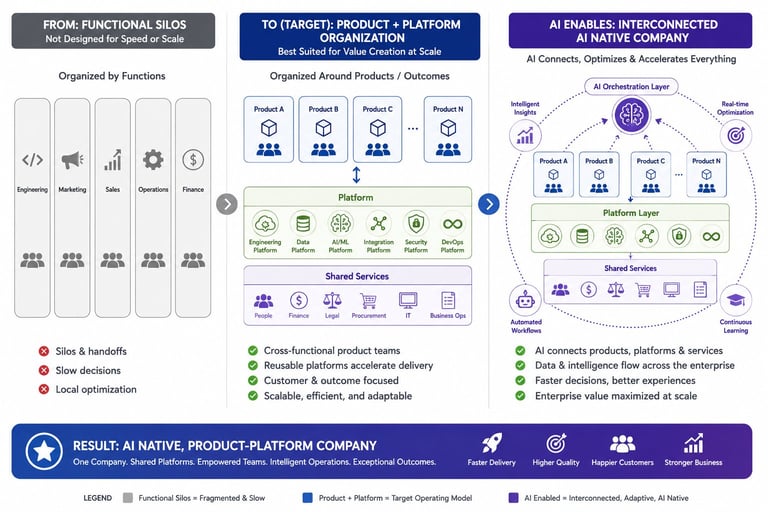
Draw boundaries around products and platforms, not departments.
Give each team end-to-end ownership of its outcomes, budget, data, and AI use cases — not a backlog handed down from IT.
Build shared platforms before point solutions.
A common data, model, and tooling layer lets every product team reuse the same AI capability instead of each one rebuilding it.
Make AI self-service, not a ticket queue.
Stable interfaces and clear ownership let teams pull AI capability when they need it, without waiting on a central committee.
Fund the redesign, not just the license.
The evidence is consistent: workflow redesign and operating model maturity predict AI value capture far more than the AI tool itself does.
Sponsor this at the top.
Structural change of this kind needs the same executive ownership as any other operating model decision — it is not an IT initiative.
Every paradigm shift I led rewarded the companies that fixed their structure before the technology got interesting, not after. AI is no different. It's just faster, and less forgiving of the delay. If your organization is still asking which AI tool to buy before it has asked whether its teams are structured to absorb one, that's the conversation worth having first.
At Project Brilliant, our AI Diagnostic assesses exactly this: where your organization already resembles a product-and-platform model, where it doesn't, and the fastest, most financially disciplined sequence of moves to close the gap for your specific mix of products, platforms, and services. Our Product Value Stream Workshop identifies, defines, and organizes your product, platforms, services, and teams. If you're evaluating whether your structure is ready to capture AI value at the speed you need, we welcome a conversation.
PROOF IN PRACTICE
We guided a financial institution to reorganize around long-lived product value streams, doubling productivity, reducing cycle times by more than 50%, restoring business confidence, and establishing the product operating model required to continuously deliver value and scale AI with confidence.
If you are ready to move from experimentation to enterprise value, let's talk.
gervais@projectbrilliant.com
projectbrilliant.com
AI Disclosure: I used my writing assistant Claude to help me draft, review, and edit this story. In my own words and tone. It is based on a real person, me. I am a paradoxical human running as fast as I can living with my truth, and not ready to slow down or "retire."
Project Brilliant Recognition: I thank Grace Sondermann, Andy Lien, and Aaron Kopel for their ideas, editing, and collaboration.
1 McKinsey & Company, "The State of AI in 2025: Agents, Innovation, and Transformation," Global Survey (fieldwork June 25–July 29, 2025; 1,993 respondents across 105 countries), November 5, 2025, https://www.mckinsey.com/capabilities/quantumblack/our-insights/the-state-of-ai.
2 Aditi Chawla, Martin Harrysson, Hannah Mayer, and Megha Sinha, "The Bottom-Line Benefit of the Product Operating Model," McKinsey & Company, December 19, 2023, https://www.mckinsey.com/capabilities/tech-and-ai/our-insights/the-bottom-line-benefit-of-the-product-operating-model.
3 McKinsey & Company, "Life Sciences Technology Insights: Scaling a Product and Platform Model," https://www.mckinsey.com/industries/life-sciences/our-insights/life-sciences-technology-insights-scaling-a-product-and-platform-model.
4 Bain & Company, "Are You Organized to Reap Value from Generative AI?" June 27, 2024 (updated September 2025), https://www.bain.com/insights/are-you-organized-to-reap-value-from-generative-ai/.
5 Bain & Company, "How Companies Create Value with AI: Redesign, Not Tools," https://www.bain.com/insights/how-do-companies-create-value-with-ai/.
6 DORA (DevOps Research and Assessment) / Google Cloud, "ROI of AI-Assisted Software Development," 2026 DORA Report, https://cloud.google.com/resources/content/dora-roi-of-ai-assisted-software-development.
7 Stuart Winter-Tear, AI advisor and author of UNHYPED, quoted in Team Topologies, "AI Success," https://teamtopologies.com/ai-success.