Shared learnings from the AI trenches
By Gervais Johnson, Senior Director of AI Strategy, Project Brilliant

Eighty-eight percent of organizations now use AI in at least one business function. As of Q2 2026, only 1% describe their rollout as mature. That gap — between broad experimentation and real enterprise value — is where most transformations stall.
If your pilots are generating headlines but not P&L impact, this is written for you.
The window is open, but it will not stay open indefinitely. Companies that lead with AI are growing revenue up to 3.7 times faster than laggards, and 73% of CEOs plan to increase AI investment over the next twelve months. The advantage is real, and it is compounding. The question is no longer whether to move. It is whether you will build the discipline to convert motion into value before the window narrows.
AI Transformation is not the same as AI Adoption. AI Fluency is not the same as using AI.
Having spent the last several years inside one of the industry's largest AI transformations, and having led four prior technology paradigm shifts, I have come to a simple conclusion. AI transformation fails or succeeds on the same fundamentals that have always separated real transformation from expensive pilots: strategy, leadership, product operations, and high-performing teams. AI simply raises the stakes and compresses the timeline. The AI paradigm shift is a business and workforce transformation.
Gartner's AI Hype Cycle names the pattern well: a Peak of Inflated Expectations followed by a Trough of Disillusionment stalls progress. Organizations rush into proofs of concept, generate early buzz, and then confront a hard truth.
A working model is not the same thing as a working business process.
The research converges on why. The World Economic Forum, MIT, Accenture, PwC, and McKinsey all trace the stalling and lack of value realization of GenAI and Agentic AI to the same source: bolting AI onto existing workflows, instead of redesigning how work actually gets done. Many companies are implementing AI ad hoc, resulting in fragmented delivery and suboptimal results.
In our experience, redesigning workflows and business operations are critical, but how to identify and execute is where most AI transformation initiatives stall, missing one or more of these three capabilities:
Comprehensive and cohesive strategy with named, and actively engaged, executive ownership
Governance operations that keep pace with rapidly shifting AI capabilities and economics
Change management plan that treats transformation as seriously as it does the technology
I have read hundreds of research papers, playbooks, books, and frameworks, and was a leader for one of the largest AI transformations while learning and adapting along the way. Much of the published guidance now converges on the same ideas. I'm honored to have been one of the first to build and execute this approach in practice, and it's validating to see the research land in the same place. Based on my experience, here are the lessons that matter most.
Create and execute a comprehensive AI enterprise strategy and organizational change management plan, with executive leadership named, outcomes defined, and instrumentation in place. The experimentation phase is ending. Be intentional about the journey.
Stay alert to AI economics. They are shifting rapidly and will impact your ROI and EBITDA.
Redesign or augment, and automate your value streams, workflows, and processes where it is financially rewarding and technologically feasible. Be prepared to stop, pivot, or expand.
Organize teams around products aligned to customers, and their supporting platforms and services. Embrace the product operating model to accelerate integration and benefit realization across an interconnected enterprise.
Evolve your IT and engineering approach for the AI era: incremental discovery and delivery, service management integrated for production-ready AI at scale. Agile is not dead, it is evolving.
Prepare for the human-machine workforce. By 2030, agentic AI is widely expected to work alongside people as digital employees. Grow your human talent and retain institutional knowledge.
Treat data as a product and your IP moat. Consider building your own models; model sovereignty will become a competitive advantage.
Get AI governance and cybersecurity right early, and be ready to adapt as the landscape shifts.
Avoid long-term vendor lock-in. The pace of technology change is unpredictable.
The organizations pulling ahead follow a disciplined, iterative path rather than a single big-bang rollout. The same discipline shows up across McKinsey's Steer-Scale-Institutionalize model, Gartner's crawl-walk-run guidance, and BCG and MIT Sloan's research on AI maturity. At Project Brilliant, we quickly apply that discipline across three activities.
Before any AI journey begins, get an honest read on where you actually stand. We evaluate leadership capabilities, product operations, teams, data maturity, technology stack, and governance, then convert that into a prioritized, financially justified set of recommendations to optimize the future state organization.
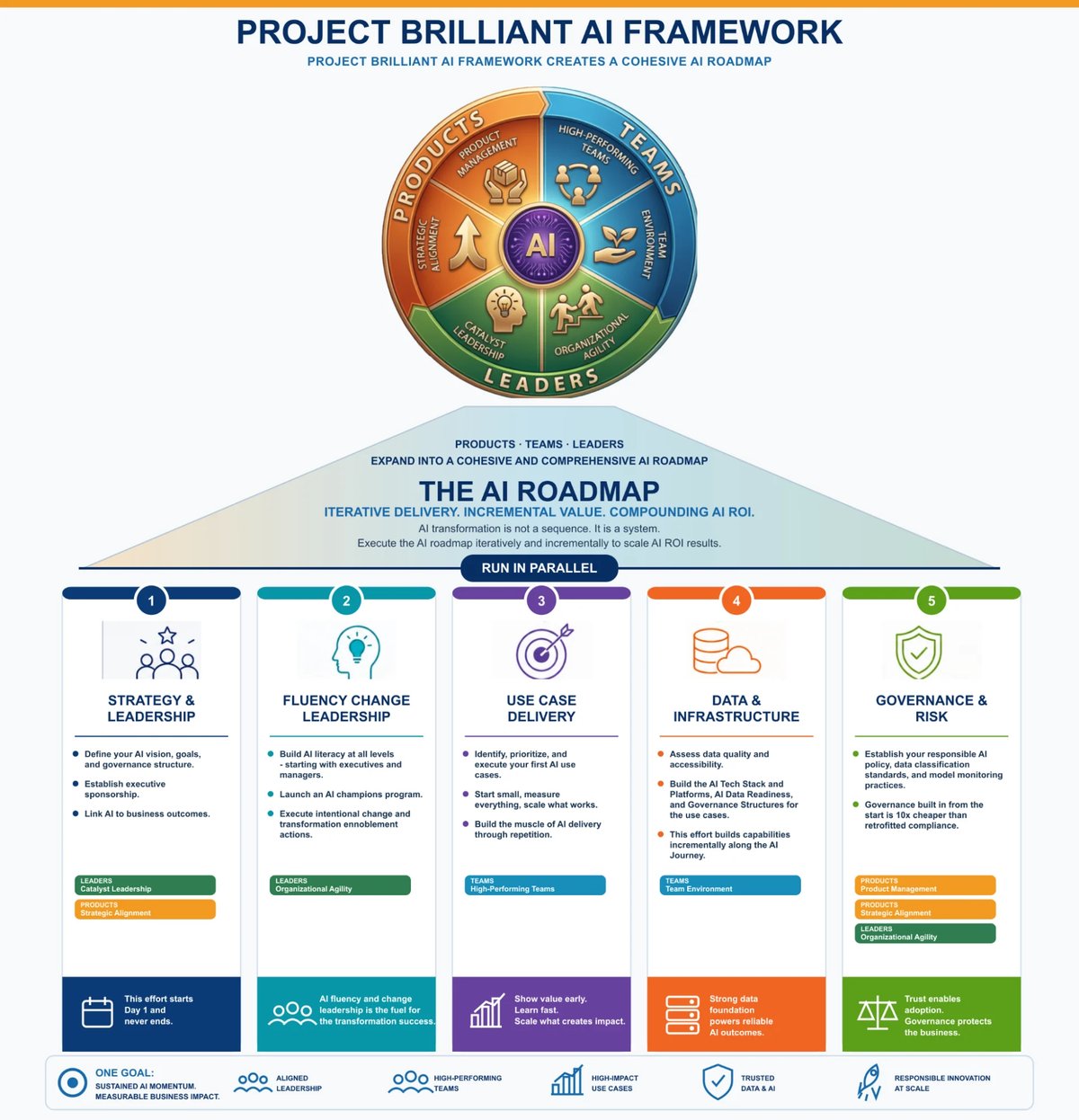
AI strategy cannot be handed down from a slide deck. It has to be co-created with the executives who will fund and sponsor it. That means a clear AI vision and guardrails, a governance framework with named decision rights, and business use cases with real ROI and payback math so the first investment decision is a confident one. We leverage the Project Brilliant AI Framework to craft the strategy and build the coherent, cohesive, and comprehensive implementation roadmap.
Strategy without disciplined delivery is just aspiration. This activity pairs agile and incremental delivery with genuine organizational change management, so the first pilot becomes the second, the second becomes ten, and the organization builds a repeatable operating model rather than a one-off win. We provide expertise to lead the AI execution and people to help build and scale the solutions, with the intent to build the capabilities and competencies within your workforce.
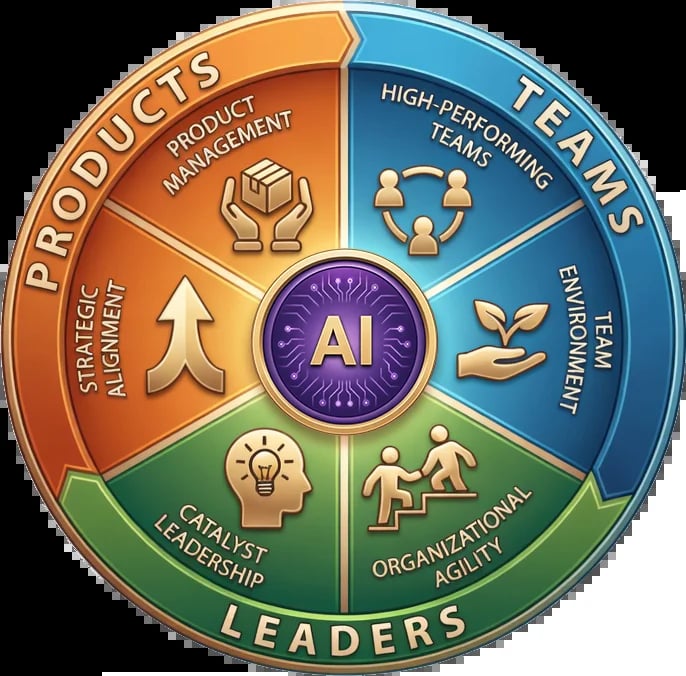
Contains 4 capability domains: Products, Teams, Leaders, and AI. The Project Brilliant AgileOS® Model by Aaron Kopel is the foundation of the AI Framework. Within each domain, we have defined system capabilities and supporting competencies that organizations need to build organizational agility and succeed in an AI-native business environment. We leverage the framework to perform the AI Readiness Diagnostics and the co-creation of the AI Strategy and Roadmap.
Products
Teams
Leaders
AI
The framework provides the foundation for our AI Readiness Diagnostic and AI Strategy and Roadmap Workshop.
Following this approach, a company initiated and completed their initial GA releases of 19 GenAI and AgenticAI products within one year — including creating the strategy, building AI fluency, implementing governance, adding the workforce needed, and building the technology infrastructure to support AI development and continuous support. One use case reduced revenue leakage and recovered millions within a few months. Another created a new business opportunity increasing R&D results using a federated learning model training platform and a data-model network.
AI is not another technology transformation or adoption program. It is a once-in-a-generation opportunity to redefine how your enterprise competes, operates, innovates, and grows.
The organizations that lead this shift will not simply deploy new technology. They will reinvent how decisions are made, how work gets done, how talent creates value, and how markets are shaped. The future will belong to leaders who move with clarity, conviction, and speed.
Every meaningful transformation begins with the courage to confront current-state challenges. Project Brilliant's AI Readiness Diagnostics gives executives a clear, enterprise-wide view of what is accelerating progress, what is creating friction, and where the greatest value is waiting to be unlocked. We examine the full system: strategy, leadership, products, teams, and AI operating model. The result is not another assessment report. It is a shared executive truth, a financially grounded transformation change backlog, and a clear set of priorities that creates alignment around where to act first. Clarity replaces uncertainty. Alignment replaces fragmentation. Momentum begins and is sustained.
Ambition alone does not create transformation. Strategic choices do. Through the AI Strategy and Roadmap, Project Brilliant brings leaders together to define where AI will create differentiated value, which capabilities must change, and how the enterprise will evolve. Using the readiness findings and our AI Framework, we co-create a practical strategy aligned to business priorities, market opportunities, investment capacity, and organizational readiness. The result is a strategy the executive team owns, a roadmap the organization can execute, and an investment narrative the board can believe in. AI moves from a collection of ideas to an enterprise commitment.
Execution is where leadership intent becomes enterprise value. Through AI Execution and Scale, Project Brilliant works alongside your leaders and teams to deliver priority outcomes, build new capabilities, strengthen AI fluency, and redesign the operating model for speed, accountability, and scale. People gain confidence. Teams move faster. Decisions improve. Silos begin to disappear. The result is measurable business impact, sustained organizational momentum, and an enterprise capable of continuously turning AI innovation into growth, productivity, and competitive advantage. This is how AI stops being an initiative and becomes the engine of the enterprise.
Transformation does not begin everywhere at once. It begins with the critical 1%: the right leaders aligned around the right priorities, making the first bold decisions that unlock the other 99%. Project Brilliant helps leaders find that 1%, act on it, and turn it into enterprise-wide transformation.
Project Brilliant helps leaders move from AI adoption to measurable business impact through strategy, readiness, and disciplined execution.
Let's TalkAI Disclosure: I used my writing assistant Claude to help me draft, review, and edit this story, in my own words and tone. It is based on a real person, me. I am a paradoxical human running as fast as I can living with my truth, and not ready to slow down or "retire."
Project Brilliant Recognition: I thank Grace Sondermann, Andy Lien, Diana Williams, and Aaron Kopel for their ideas, editing, and collaboration.
Aaron Kopel, 2025, Unlocking Momentum: The CIO's Keys to Accelerating Change and Becoming a Strategic C-Level Partner, Niche Pressworks, Project Brilliant, LLC.
Barry O'Reilly, 2026, Artificial Organizations: Build Better Judgement, Speed, and Results with Human and Machine Intelligence.
Paul Daugherty and H. James Wilson, 2024, Human + Machine: Reimagining Work in the Age of AI, Harvard Business Review Press.
Eric Lamarre, Kate Smaje, and Rodney Zemmel, 2023, Rewired: The McKinsey Guide to Outcompeting in the Age of Digital and AI, Wiley.
McKinsey & Company, "The State of AI: How Organizations Are Rewiring to Capture Value," Global Survey, March 2025. https://www.mckinsey.com/capabilities/quantumblack/our-insights/the-state-of-ai
World Economic Forum, Future of Jobs Report 2025, January 2025. https://www.weforum.org/publications/the-future-of-jobs-report-2025/
Stanford HAI, AI Index Report 2026. https://hai.stanford.edu/ai-index
IBM Institute of Business Value CEO Study (2025). https://www.ibm.com/thought-leadership/institute-business-value
PwC 2025 Global AI Jobs Barometer. https://www.pwc.com/gx/en/issues/artificial-intelligence/ai-jobs-barometer.html
MIT Sloan Management Review, research on AI, workflow redesign, and organizational transformation. https://mitsloan.mit.edu/ideas-made-to-matter
Accenture Technology Vision and Generative AI research. https://www.accenture.com/us-en/insights/artificial-intelligence
Deloitte, State of Generative AI in the Enterprise. https://www2.deloitte.com/us/en/pages/consulting/topics/generative-ai.html
BCG AI at Work research. https://www.bcg.com/capabilities/artificial-intelligence
Prosci ADKAR Change Management: https://www.prosci.com/
John Kotter Change Management: https://www.kotterinc.com/